Read my hallmark
Type every mark you can see, in any order. The marks are read together, and the answer is the country, the metal and, where the system allows it, the exact year.
GUIDE: Write all of it in the box, in any order, with a comma between each separate mark - you do not need to know what any mark means. The comma is what tells us where one punch ends and the next begins: lion, crown is two marks, crowned lion is one. Numbers and letters go in exactly as they read, and anything that is a picture goes in as words, spelt the way you would say it: 925, 18K, 830S, a, T9, CFH, anchor, three crowns, lion, kings head, cockerel.
Half of it will do. One figure and one shape is enough to start.
No marks at all, or too worn to read? Then there is nothing here to read. Use date your piece instead - it works from the clasp, the fittings and the construction, no marks needed.
A worked example
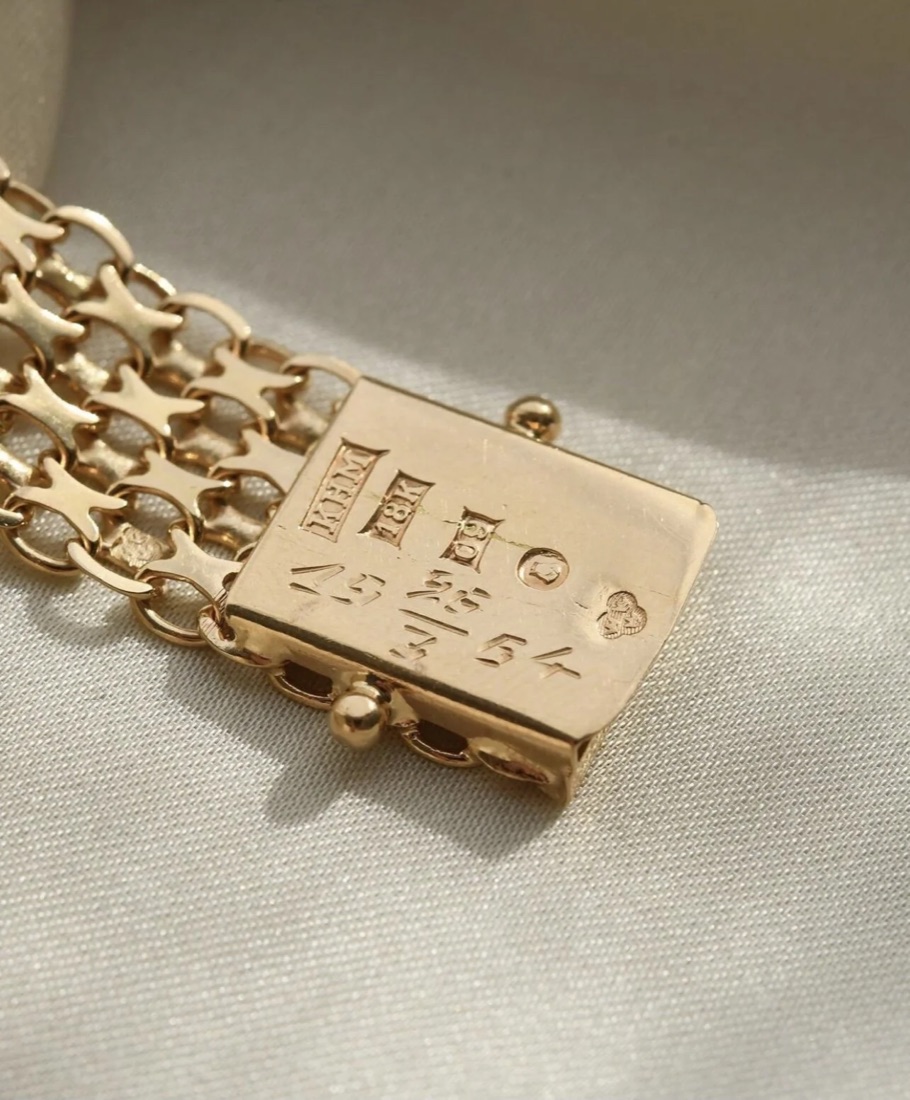
Left to right: KFM, the maker. 18K, the fineness. A letter with a small numeral, the date. A round town mark. Last, the three crowns in their trefoil, Sweden's national mark.
You do not need to know which is which - you type what you can see:
Where the marks actually are
Most people conclude a piece is unmarked after looking at the front. Marks are struck where they will not show and where the metal is thick enough to take a punch without distorting.
- Rings. Inside the shank, usually at the bottom opposite the setting. If the ring has been sized, the marks are often the casualty.
- Brooches. On the pin stem, on the catch, or on the flat of the frame near the hinge.
- Earrings. On the post, the clip plate or the very edge of the back.
- Chains and bracelets. On the clasp, on the jump ring beside it, or on a small separate tag. A marked clasp does not mark the chain: clasps are replaced constantly.
- Pendants and lockets. On the bail, the rim, or inside the back cover.
Use a 10x loupe and raking light, not overhead light. Worn marks come back into legibility when the light comes from the side. Read more in the full guide to reading marks.
Whose registers this reads
Maker's marks are the part nobody can look up, because a mark can only be traced where a state kept a register. Where an official register exists and is public, this tool reads it.
- Denmark. The complete Navnestempelregister from Ædelmetalkontrollen: 7,803 registered stamps from 1892 to today, with the year each was registered and the year it lapsed.
- Sweden. The complete Namnstämpelregister from Swedac: 10,024 registered marks, the earliest from 1836, with the town and the years of registration.
- Britain and Ireland. 15,664 sponsors' marks across all ten assay offices, from Silver Makers' Marks, used with the owners' permission. Decades of work by people who photographed real hallmarks, and the single best British reference there is.
- Finland. The Nimileimarekisteri from Tukes, used with the agency's permission: 5,857 responsibility marks, the earliest from 1904, with the town and the years each mark was valid.
That is 39,348 marks from four sources, searched together. If the same letters were used in more than one country, you get all of them, and the years tell you which one you are holding.
We leave out the street addresses, postcodes and websites that the Swedish register carries, and the photographs of each punch that the Finnish one carries. The first identify living people and are no help in dating an object; the second are no help to a text search.
France is the exception, and it is worth knowing why. There is no public register of French makers' punches: the archives of the poinçon de maître sit in the Archives Nationales and have never been published as a list. So a French lozenge can be dated and identified as French, but usually not named. Anyone selling you a complete French makers' index is selling you a book, not a register.
Those years are worth as much as the mark itself. A Danish piece struck G.J. was registered to Georg Jensen in 1904 and the registration lapsed in 1937, so the mark and the three towers date should agree. Where they do not, one of them was added later.
What it can and cannot tell you
Four countries, four different answers, and the difference is not our data but their law.
| Country | Best it can do | Why |
|---|---|---|
| Denmark | The exact year | The year is struck as two digits under the three towers. Nothing needs decoding at all |
| Sweden | The exact year | Letter plus numeral is a calculation from A in 1759 |
| Britain, London | The exact year, usually | Twenty-letter cycles anchored on a known year, then narrowed by the other marks |
| Britain, from 1975 | The exact year | All four offices share one cycle after the Hallmarking Act 1973 |
| Britain and Ireland, other offices before 1975 | The exact year, as candidates | All ten offices are transcribed cycle by cycle, each with its own letter sequence. The letter repeats across cycles, so it gives a short list of years; the maker's registration usually settles it |
| Spain | Standard, sometimes a region | Marking was regional and unsystematic until the twentieth century. There is no year to find |
What narrows a British date letter
A letter on its own repeats every twenty or twenty-five years. These marks each cut the possibilities down, and two or three together usually leave one.
- The monarch's head means 1784 to 1890. It is the sharpest single constraint in British hallmarking.
- 15ct or 12ct means 1854 to 1932, because those standards existed only in that window.
- 14ct or 585 means 1932 or later in Britain.
- Platinum means 1975 or later as a hallmark, and 1900 or later as a metal.
- Palladium means 2010 or later.
- A closed office is a hard ceiling: Exeter 1883, Newcastle 1884, Chester 1962, Glasgow 1964.
The step a text box cannot do
British cycles are told apart by the typeface of the letter and the shape of the shield around it. A lower case Gothic g in a shield is a different year from a Roman capital G in a rectangle, and no amount of typing captures that. When this tool gives you two or three candidate years, that is the honest answer, and the way to close it is to compare the punch itself against the cycle table for that office.
The systems themselves are set out country by country under hallmarks, and single marks can be looked up in the decoder.
Frequently asked questions
How do I find the year on a British hallmark?
Read the date letter together with the assay office mark. Each office ran its own cycle, so the same letter means different years in London and Birmingham. Once you know the office, the other marks - the duty mark, the standard, the fineness figure - rule out all but one or two cycles.
How do I read a Danish hallmark?
Look for three towers in a row with two digits beneath them. Those digits are the year of assay: three towers over 24 means 1924. The assay master’s initials beside them narrow it further if the digits are worn.
How do I read a Swedish date letter?
Swedish letters run in 24-year cycles from A in 1759, omitting J, W and the vowels with diacritics. From 1783 a numeral was added for each new cycle, so A2 is 1783 and A3 is 1807. Letter and numeral together give the year exactly.
Why does my hallmark give more than one possible year?
Because the letter repeats each cycle. Distinguishing cycles needs the typeface and the shape of the surround, which cannot be entered as text. Adding another mark, particularly the duty mark or the fineness, usually narrows it to one.
Can Spanish silver be dated from its marks?
Rarely. Spain had no national date letter system before the twentieth century and marking was issued by individual cities and guilds. Spanish work is dated from its construction instead.