Date Letters Explained: How One Stamped Letter Names a Year
A single letter, struck two millimetres tall, can name the exact year a piece passed through an assay office. It is the closest thing antique jewelry has to a birth certificate, and reading it correctly means knowing which alphabet, which office and which cycle you are looking at.
Of all the marks on old metal, the date letter is the one that feels like magic: a lowercase k in a shield, and suddenly the catalogue entry says 1905 without a question mark. The magic is really bookkeeping. Assay offices needed to know which year, and often which official, answered for a piece, so they stamped the year in code, and the code books survive. What follows is how the code works, and the traps in it.
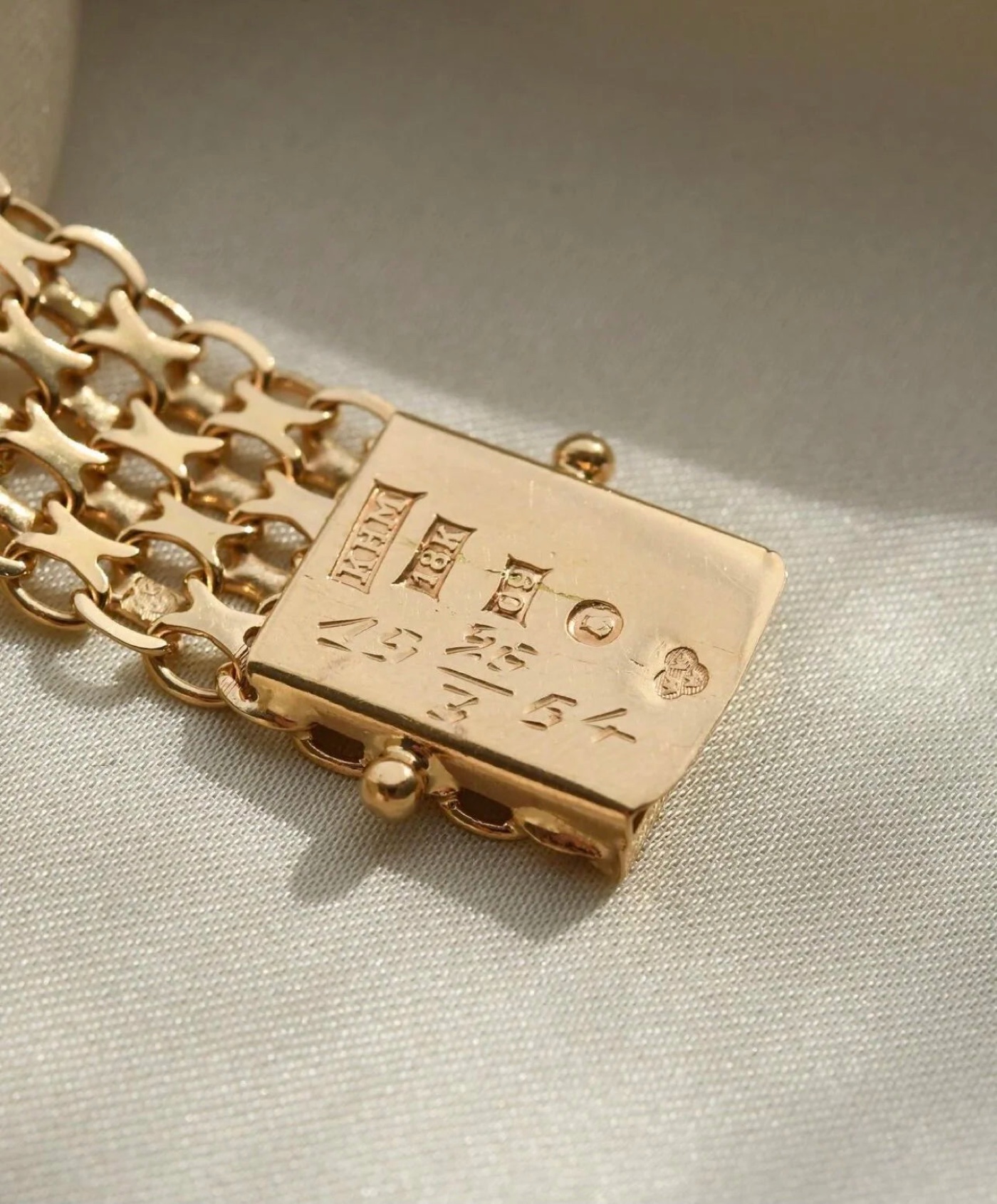
The principle: alphabets as calendars
A date letter system assigns each year a letter, A for the first year of a cycle, B for the second, and so on. When the alphabet runs out, the cycle restarts, and to keep cycles apart the office changes the letter's typeface and the outline of the shield it sits in. So a date letter is read as three facts together: the letter itself, the style of the letter, and the shape of its cartouche. The letter names the year within the cycle; the style and shield name the cycle.
That is also the first trap. A bare "K means 1905" table is only true for one office, one cycle. The same K in a different font is a different decade, and in a different office a different century. No date letter can be read without first answering: whose alphabet is this?
Britain: the grand system
The British offices ran the most famous date letter machinery, and every office ran its own. London's cycles used a twenty-letter alphabet; other offices chose their own alphabets, their own skipped letters and their own start years, and the variations are genuinely wild: Sheffield's early cycles used letters in an arbitrary order, Chester cut cycles short and restarted, Dublin once kept j while skipping i. Nothing about a British date letter can be safely generated from rules; it must be looked up, office by office, cycle by cycle, which is precisely what our hallmark reader does, with the verified cycle tables for London, Birmingham, Sheffield, Edinburgh, Chester, Glasgow, Newcastle, Exeter and Dublin behind it.
Two refinements matter for precision. British date letters changed mid-year, at the office's own new year rather than the calendar's, so a letter properly denotes an assay year, 1882 to 83, and tables that print a single year are rounding. And from 1975, the Hallmarking Act synchronised the surviving offices onto one shared cycle, ending six centuries of divergence.
Sweden: the arithmetic exception
Sweden is the collector's reward for learning one formula. Since 1759 the Swedish system has run a single national series: an alphabet of 24 letters, omitting J, W, Å, Ä and Ö, each cycle numbered. A2 is not a mystery: it is the letter A in the second cycle. The year is pure arithmetic, 1759 plus 24 for each completed cycle plus the letter's position, so A2 is 1783 and T9 is 1969. An unbroken, calculable series across 260 years is unique in Europe, and it makes Swedish gold and silver among the most precisely datable objects in the entire antique trade.
Denmark: digits instead of letters
Denmark solved the same problem with less poetry and equal effect: under the three-towers mark, used on silver from 1608 to 1977, the year is stamped as two digits directly beneath the towers. Three towers over 34 is 1934. The century is resolved by the accompanying assay master's mark, since each master's tenure is documented, and the combination dates Danish silver as tightly as any letter system. The full Nordic picture, including how the Swedish three crowns and Danish three towers are told apart, lives on the country pages.
Reading a date letter without fooling yourself
The working order, from the bench: identify the country first, from the whole row, fineness style, town mark, control marks. Identify the office where the country has several. Only then open the right table and match letter, font and shield together, all three, because a letter matched without its font is a guess wearing a monocle. Cross-check the answer against everything else the piece says: a date letter reading 1791 on a piece with a 14ct mark, a standard Britain only permitted from 1932, has been misread, and the arithmetic always wins such arguments. The general hallmark guide walks the full row; the date letter is its sharpest single instrument.
And when there is no letter at all, France famously never used one, the piece is not undatable; it is dated by other windows, as the French hallmarks article shows.
Frequently asked questions
What is a date letter on jewelry or silver?
A letter struck by an assay office encoding the year of assay. The letter's font and its shield outline identify the cycle; the letter identifies the year within it.
Can I read a date letter from the letter alone?
No. The same letter recurs every cycle and differs between offices. Letter, typeface and shield shape must be matched together in the correct office's table.
Which countries used date letters?
Britain and Ireland most famously, and Sweden with its calculable national series from 1759. Denmark stamped year digits instead. France never used a year mark, dating instead by changes in its guarantee marks.
Why does my British piece's date letter table show 1882-83 rather than one year?
Because letters changed at the office's own new year, mid-calendar. A date letter denotes an assay year spanning parts of two calendar years; single-year tables are simplifications.
How do I date a Swedish piece from its marks?
Find the letter-plus-number code and compute: 1759 plus 24 times one less than the cycle number, plus the letter's position in the 24-letter alphabet that omits J, W, Å, Ä and Ö. The town mark then confirms where.
Are date letters ever faked?
Occasionally, alongside other marks on forged rows, but faking a letter correctly, right font, right shield, right companions for that office and year, defeats most forgers. Inconsistency between the letter and the rest of the row is exactly how fakes are caught.